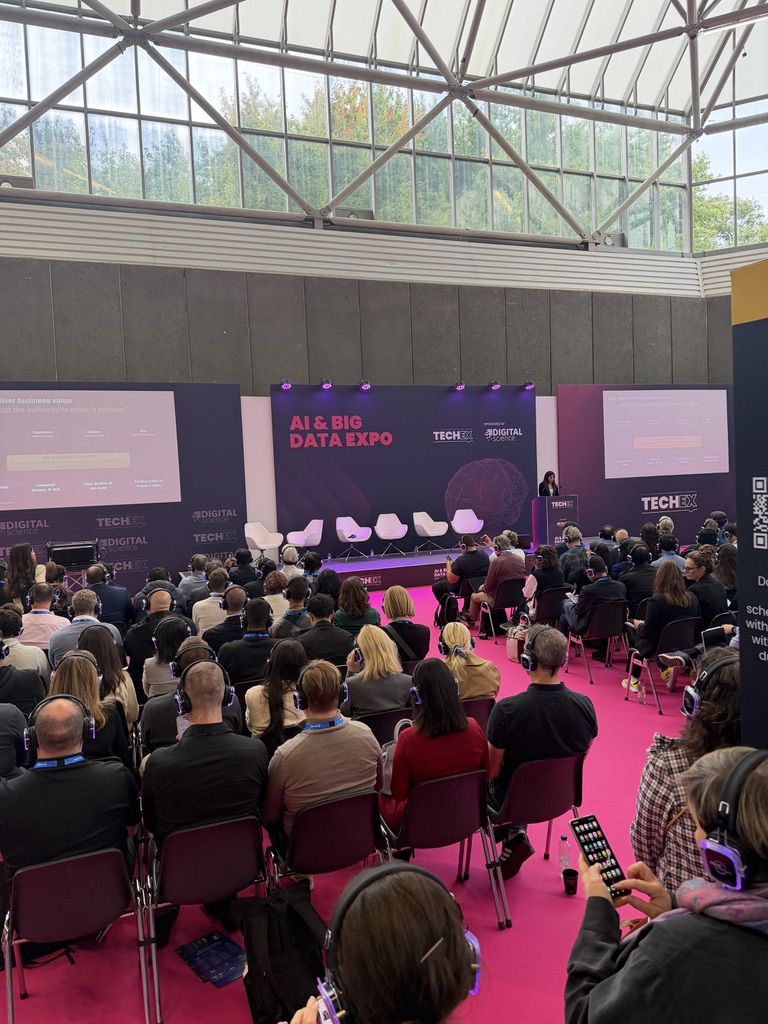
What We Learnt at the TechEx AI & Big Data Expo Europe, Amsterdam
Written by Anna Parrish
We interviewed professionals at the TechEx AI & Big Data Expo Europe. Here is what they said AI gets wrong, which skills will matter most, and what it means for hiring.
2 November 2026 · 6 min read
AI was the only topic anyone wanted to talk about at this year’s AI & Big Data Expo Europe in Amsterdam. So instead of adding to the noise, we asked people directly. We sat down with 14 professionals from vendors, consultancies and in-house data teams, from Oracle, Splunk and Starburst Data to Eneco Energy and Orq.ai, and put the same three questions to each of them:
- What is the one thing everyone is saying about AI right now that you think is wrong?
- Which skill will be worth more in five years because of AI, and which will be worth less?
- What is one word to describe AI in 2026?
The answers were more consistent than we expected. Here is what we learnt.
The short version
Five themes ran through almost every conversation.
- AI is an assistant, not a magic pill. Data, context and a clear business goal have to come first.
- The job-loss panic is overcooked, but the task-loss story is real. Repetitive, standardised work is what is disappearing.
- Judgement is the premium skill. Critical thinking, context and decision-making came up again and again.
- Pilots are easy; value is hard. Implementation, success criteria and usable governance are where companies get stuck.
- The mood is promise with a side of unease. Our 14 one-word answers ranged from “exciting” to “scary”.
“It’s not a magic pill”
The most common answer to our first question was a version of the same message: AI will not do everything for you. Richard Serio of Howspace put it simply, calling AI “an assistant, not a replacement” that still needs a human to guide it.
Two guests pointed to data as the missing ingredient. Yurii Maslov of DigitalSuits said that without data, AI cannot work with the right context or deliver real value. Dr Gurpinder Dhillon of Senzing agreed, adding that AI relies on data far more heavily than most people realise.
Vincent Cardon of Apryse urged companies to check they are ready before they implement anything, and to ask what added value AI needs to bring rather than assuming it will. Boaz Kwakkel of Splunk went further and predicted a drop-off in “AI for everything”, with tools consolidating around the use cases that actually return the investment. Aatish Kumar of Eneco Energy offered the shortest correction of the day: AGI is not here yet.
Victoria Sybel-Scott of Starburst Data thought both camps were wrong. People inside AI say it will solve everything, people in the business say it is an overhyped toy, and the reality sits somewhere in the middle.
But don’t wait around
Not everyone was worried about over-promising. Several guests were more concerned about hesitation.
- Vivek Bhati of Almodus said too many businesses are still waiting for more confidence and safety conversations, when many have already cracked the problems they set out to solve.
- Egbert Wietses of Pionect disagreed with anyone who thinks AI is moving slowly. In his view it is going very fast and will have a lot of influence in the coming years.
- Marc Meyer of In the Pocket rejected the bubble narrative. AI is here to stay, he argued, like the internet or electricity, and will simply become the new standard.
On jobs, Jaime Speijer of Oracle and Rogier Van Erkel of Digital Science made the same point independently. AI will change how people work and make them more productive, but it is more likely to enhance roles than remove them.
Governance, shadow AI and the pilot trap
Henrik Maurin of Turbotic raised the sharpest point on the practical side. Everyone at the Expo was talking about governance, security and compliance, which he said is only one side of the coin. If the approved tools are slow or hard to use, employees will turn to shadow AI instead, so companies need security and speed together.
He also described a pattern where companies push small pilots into production one use case at a time without rethinking the wider business process. His verdict on 2026: the models keep improving, but the value for shareholders has not been realised yet.
The skills that will be worth more
When we asked which skills will gain value, the answers clustered around judgement rather than technical ability.
- Asking tough questions and thinking critically. Victoria Sybel-Scott warned that it is easy to accept the first answer AI gives you. Marc Meyer said that in a world where anyone can build anything quickly, asking why we are building it is worth far more. Vincent Cardon made the same point from the reading side: everybody now uses AI to write emails, so you need to genuinely understand what you are sending and receiving.
- Providing context. Dr Gurpinder Dhillon called context king. Rogier Van Erkel said the winning skills are conceptual thinking, being critical of the results and providing strategy and direction, so you can delegate the heavy lifting.
- Making decisions. Aatish Kumar expects less value in discovering and finding things, and more in deciding what is right and wrong.
- Breaking down the problem. Vivek Bhati said no AI will replace the ability to break down a business problem well, and that everyone from a CXO to a graduate should learn it.
- Leading and implementing change. Richard Serio pointed to transformation leaders for digital and cultural change. Henrik Maurin wants people who can turn AI use cases into real business processes.
- Defining success. Cameron Mckelvie of Orq.ai highlighted the ability to set and demonstrate success criteria, something teams rarely prioritise in week one but badly miss by week ten.
- Overseeing many systems. Egbert Wietses expects people who can keep an overview of many agents to be in high demand. Boaz Kwakkel believes guiding agentic and even physical AI systems is a skill we are still underestimating.
- Knowing how to use AI. Jaime Speijer said prompting and understanding AI’s power and limits will separate those who keep up from those who fall behind.
The skills that will be worth less
The list of declining skills was just as consistent. It is mostly work that is manual, repetitive or easily standardised.
- Data entry and invoice processing. Richard Serio named menial data entry, and Victoria Sybel-Scott pointed to accounts payable teams keying in invoices.
- Gathering and crunching data. Dr Gurpinder Dhillon expects manual data gathering to fade, and Marc Meyer said number crunching is easy for AI, although interpreting the results still takes critical thinking.
- Repeating one task. Egbert Wietses said anyone who does one particular thing over and over has a high chance of being automated.
- Routine coding. Yurii Maslov argued that coding is already largely replaced in small and medium businesses and is heading into the enterprise too. In his view, data engineering and data analysis will be the in-demand skills within two to three years.
- Making slides. Cameron Mckelvie joked that his years of building PowerPoint decks are now worthless.
What this means for hiring
These are our conclusions rather than anything our guests said, but the pattern points in a clear direction for anyone building an AI or Data team.
- Test for judgement, not just tooling. If critical thinking, context and decision-making are the scarce skills, interviews should probe how candidates challenge an answer, not only which tools they have used.
- Data fundamentals still matter. Two guests tied AI’s value directly to the quality of the data underneath it, so strong data engineers and analysts remain the foundation.
- Value the people who ship. Moving from pilot to production, with clear success criteria and a view of the whole business process, was a recurring gap. Candidates who have done that are worth looking for.
- Expect new oversight roles. Managing fleets of agents and guiding agentic systems is an emerging skill set that few people can claim yet.
- Rethink entry-level work. Several of the tasks expected to shrink are the ones that often make up early-career roles, so it is worth asking how those roles will be shaped.
One word for AI in 2026
There was no consensus here, and that was telling. Optimistic words like potential, promising, exciting and powerful sat alongside scary, fear and confusing. “Context” appeared as both a skill and a one-word answer. Here is how each guest answered:
- Richard Serio, Howspace: Potential
- Yurii Maslov, DigitalSuits: Scary
- Victoria Sybel-Scott, Starburst Data: Misunderstood
- Dr Gurpinder Dhillon, Senzing: Confusing
- Vincent Cardon, Apryse: Competition
- Vivek Bhati, Almodus: Promising
- Jaime Speijer, Oracle: Futuristic
- Marc Meyer, In the Pocket: Stop the Slop
- Rogier Van Erkel, Digital Science: Context
- Henrik Maurin, Turbotic: Promise
- Egbert Wietses, Pionect: Powerful
- Boaz Kwakkel, Splunk: Exciting
- Cameron Mckelvie, Orq.ai: Toddler
- Aatish Kumar, Eneco Energy: Fear
Cameron Mckelvie’s explanation was our favourite: AI is no longer a baby, but it is a rambunctious toddler, full of energy and not yet fully formed.
Final thoughts
The clearest message from Amsterdam is that AI rewards people who bring something to it. The technology is moving fast, but the value comes from good data, clear context, sharp questions and the judgement to know when an answer is wrong. That is as true for hiring as it is for deployment.
If you are building an AI or Data team in Germany, the Netherlands or the UK, we would love to hear what you are seeing. Get in touch with the Oxygen Digital team.